Eight operating principles we use to design, deliver and evaluate every customer-facing activity. They describe how we hold ourselves to account — on every doorstep, shop floor, event stand and kiosk.
The standards on this page are Sterling Connect Group's own internal operating principles. They are the criteria we use when we plan a program, prepare the people who will deliver it, observe it in progress and review it afterwards. They are not a formal accreditation, a certification or a third-party audit standard, and we do not present them as such.
We publish them because clients should be able to see what we expect of ourselves before they put their brand in our hands — and because standards that are written down can be checked, challenged and improved.
The Eight Principles
How We Judge Our Own Work.
1. Brand Representation
Your brand is presented accurately, consistently and in keeping with your guidelines, by people who understand what it stands for.
2. Communication Quality
Clear, truthful and relevant communication — in what is said, how it is said and what is left unsaid.
3. Customer Respect
Courtesy, appropriate timing, acceptance of a decline and care for the customer's environment and information.
4. Program Preparation
No activity begins without a written brief, prepared representatives, confirmed logistics and agreed objectives.
5. Execution Consistency
The same standard from the first interaction to the last, maintained through supervision and routine observation.
6. Feedback Mechanisms
Every customer-facing role has a way to report what it is hearing, and every report has somewhere to go.
7. Documentation
Briefs, approvals, conduct expectations, escalation routes and reports are written down and kept current.
8. Continuous Improvement
Observations and feedback are reviewed on a regular cadence and lead to specific, recorded changes.
Principles 1 & 2
Brand Representation and Communication Quality.
When one of our representatives speaks, the customer hears your brand. That responsibility shapes who we put in front of customers and what we prepare them to say.
Brand representation covers appearance, identification, tone and knowledge. Representatives are briefed on your brand guidelines, identify themselves and the brand clearly, and are prepared to explain the offer in a way that is consistent with how you present it elsewhere. Materials used in customer-facing settings are approved by you before use.
Communication quality covers accuracy, clarity and relevance. We maintain a list of approved claims and the answers to expected questions. Representatives are told what they may not say as clearly as what they may. Pricing, terms and conditions are communicated as they are, and uncertainty is handled by saying "I'll find out" rather than guessing.
Clear identification of the representative and the brand at the start of every interaction
Brand-consistent appearance, materials and tone
Approved claims and prepared answers; no improvised promises
Plain language, with jargon explained where it cannot be avoided
Accurate pricing, terms and cancellation information
Escalation of questions the brief cannot answer, rather than guesswork
Principles 3 & 4
Customer Respect and Program Preparation.
Customer respect is the principle most visible to the public and most damaging to a brand when it slips. We expect representatives to approach at appropriate times, to accept a decline immediately and without argument, to be sensitive to the setting — a private home, a busy shop, a crowded event — and to treat personal information with care. A customer who says no should still feel the interaction was professional.
Program preparation is where most quality is won or lost. Before activity begins we require a written brief, approved materials, prepared representatives who have been briefed on the offer, the audience and the conduct expected of them, confirmed logistics, and agreed objectives and reporting. If any of these is missing, the program does not start.
Appropriate timing and respect for the setting
Declines and opt-outs accepted immediately and recorded where required
Written brief, approved materials and conduct expectations before launch
Representatives prepared on offer, audience, boundaries and escalation
Principles 5 & 6
Execution Consistency and Feedback Mechanisms.
Consistency is produced by supervision and observation. Feedback is what turns a consistent program into an improving one.
Supervised Delivery
Coordinators are responsible for the quality of what happens in the field, in store, at the event or at the kiosk. They observe interactions, compare them to the brief and address drift — in messaging, conduct or presentation — the same day.
Standard Operating Routines
Daily starts and closes, materials checks, location confirmations and end-of-day reporting follow the same routine on every program, so the basics are never left to chance.
Representative Feedback
Representatives have a simple way to record the objections, questions and reactions they encounter, and the practical problems they face. Coordinators review these daily and raise patterns with the client.
Customer and Client Feedback
Customers can raise a concern through our published contact details. Clients can raise anything at any time with their coordinator. Both routes feed into the same review process, and concerns are acknowledged and followed up.
Principle 7
Documentation Principles.
Quality that lives only in people's heads leaves when they do. We write down what matters so the program is consistent regardless of who is on shift.
Documentation is kept proportionate — enough to make the program repeatable and reviewable, not so much that nobody reads it. Every document has an owner and a date, and customer-facing materials are version-controlled so that outdated claims or pricing cannot slip back into use.
Program brief
Objectives, audience, offer, approved claims, prepared answers, conduct expectations and what to do when a question cannot be answered.
Approvals record
Which materials and claims the client has approved, when, and by whom.
Escalation routes
Who to contact, how quickly, for customer complaints, site issues, safety concerns and materials or information errors.
Activity and feedback logs
What was done, where, with what observed outcomes and what representatives reported.
Review and change record
What each review concluded and what was changed as a result, so improvement is traceable.
Principle 8
Continuous Improvement.
A standard that never changes is a standard nobody is checking. We expect our principles — and the programs built on them — to get better with use.
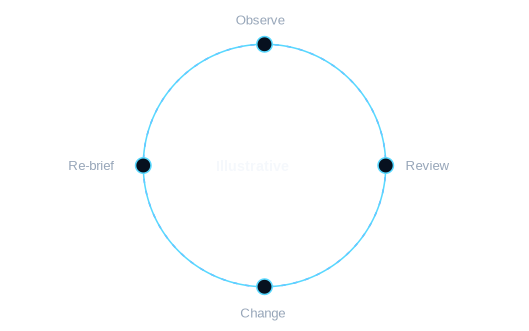
Each program review asks three questions: what did we observe, what does it suggest and what will we change? The answers are recorded. Changes are briefed to the people who need to act on them. And at the close of each program we ask the same questions of our own standards: did they help, where were they unclear, and what should be added or removed.
Scheduled reviews at agreed milestones
Specific, recorded changes rather than general intentions
Re-briefing so changes reach the people delivering the program
Periodic review of the standards themselves
In Practice
Where the Standards Show Up.
The principles are applied at four points in every engagement.
01
Design
Program plans are checked against the principles before they are proposed to you.
02
Preparation
Representatives are briefed on the standards as part of program preparation, not as an afterthought.
03
Observation
Coordinators observe against the same principles, so feedback to representatives is consistent.
04
Review
Milestone reviews include a quality section that reports against each principle, not only activity and outcomes.
Our commitments on respectful interaction, truthful representation, consent, opt-outs and data handling are set out in more detail on the Responsible Engagement page.
Standards You Can Ask About
Put Your Brand in Prepared Hands.
Ask us how these principles would apply to your program. We would rather answer the hard questions before launch than after.