Retail activations, live events and kiosk programs share one defining feature: the brand is a guest. The store belongs to the retailer. The venue belongs to the organiser. The attention belongs to a shopper or attendee who came for their own reasons and has every right to walk past. Engagement that forgets this tends to feel loud, misplaced and easy to ignore. Engagement that embraces it tends to feel welcome.
This article sets out how we think about designing in-person engagement around three things that must be respected — the environment, the host and the customer's time — and why respecting them is not a constraint on effectiveness but the source of it.
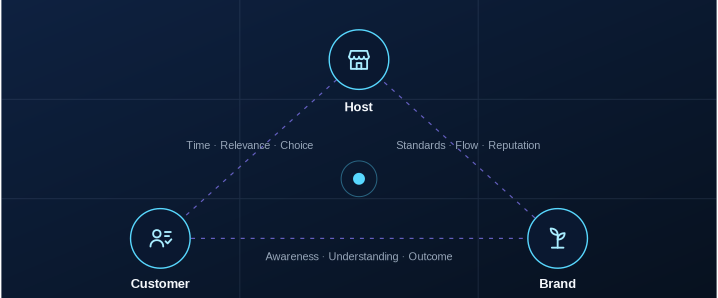
The three parties in every activation
Before planning any in-person program, it helps to name the people whose interests are in play.
A good design serves all three. A poor design serves the brand at the expense of the other two, and tends to be invited back less often.
Designing for the environment
Every location has a rhythm — peak times, quiet times, the direction people move, the points where they naturally pause. Engagement that works with that rhythm feels like part of the place. Engagement that works against it feels like an obstacle.
Position and footprint
Where you stand matters as much as what you say. A position near a decision point — the relevant aisle, the registration desk, the entrance to a demonstration area — puts the conversation where it is useful. A position that blocks flow or crowds another display creates friction before a word is spoken. Keep the footprint proportionate to the space and agree it with the host in advance.
Timing
Match staffing to the real pattern of traffic rather than a standard shift. Plan for the quiet periods too: they are often the best time for longer conversations, for restocking and for capturing observations while they are fresh.
Presentation
Materials, dress and setup should fit the setting. A premium retailer, a trade exhibition and a community event each have their own visual language, and the activation should look as though it belongs in that language rather than imported from somewhere else.
Designing for the host
The retailer or organiser is a partner, not a landlord. Treating them that way starts before the activation and continues after it.
Designing for the customer's time
The scarcest resource in any retail or event setting is the customer's attention. A design that respects it tends to earn more of it.
Make the first second count
A customer decides whether to engage almost instantly. A clear visual answer to "what is this?" and a representative who looks approachable rather than poised to pounce do most of the work. The opening line should offer something — information, a demonstration, a sample — rather than ask for something.
Give value before asking for anything
A short, honest explanation or a hands-on demonstration gives the customer a reason to stay. Asking for contact details, a purchase or a commitment before you have been useful inverts the exchange and is the fastest way to end it.
Make leaving easy
A customer who feels trapped will remember the feeling rather than the product. Keep the exit obvious, read the signals that someone wants to move on, and let them go with a thank-you. Many of the best outcomes from in-person engagement arrive later — a purchase on the next visit, a question by email — and they only arrive if the first encounter was pleasant.
Prepare for the questions that will come
Representatives should know the product well enough to answer real questions, and should know exactly what to say when they do not know. "Let me find out for you" with a clear route to follow up is a good answer. A guess is never a good answer.
Kiosks: the compressed case
A kiosk combines everything above in a small footprint and a short interaction window. The design questions are the same — position, timing, presentation, host standards, customer value — but the margin for error is smaller. A kiosk that is cluttered, poorly staffed or placed in a flow bottleneck fails quickly. One that is clear, well-positioned and staffed by people who can be useful in under a minute can be remarkably effective in exactly the places people already are.
Two kiosk-specific details are worth attention. First, the interaction workflow should be rehearsed: what the representative does when someone approaches, how a demonstration is run in a confined space, and how a sign-up or purchase is completed without creating a queue that blocks the walkway. Second, the kiosk needs a plan for the periods when nobody is approaching — how the representative stays visibly available without appearing to hover, and how the environment is kept tidy and inviting between conversations.
Putting it into practice
Whether you are planning a single in-store weekend, a multi-venue event program or an ongoing kiosk presence, these steps will improve the design.
Respecting the environment, the host and the customer's time is not a limitation on what in-person engagement can achieve. It is what makes a retailer invite you back, a venue recommend you and a customer remember the brand kindly. Those are the foundations of effectiveness, and they are what we design every retail, event and kiosk program around.