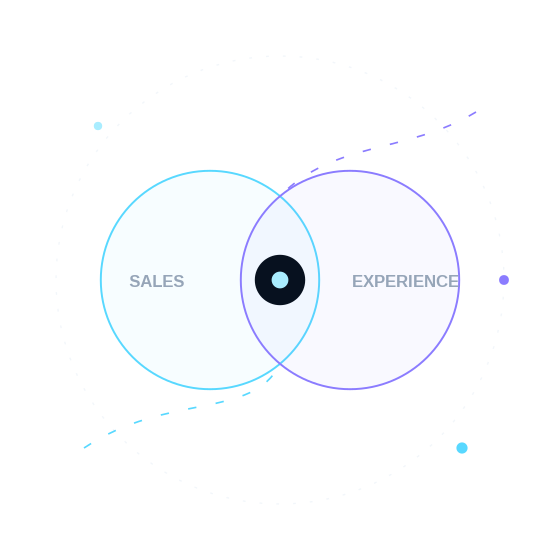
In many organisations, sales and customer experience live in different places. Sales is measured on what it brings in. Experience is measured on how people feel afterwards. The two teams may share a brand, a product and a customer, but they rarely share a plan. The consequence shows up in the customer's life as a seam: an enthusiastic sales conversation followed by an onboarding process that feels like it belongs to a different company, or a thoughtful service experience undermined by an aggressive renewal call.
The customer does not experience departments. They experience one relationship, and the way they were sold to is the first chapter of it. This article makes the case for designing sales and experience as a single system, and sets out a practical method for doing it without reorganising your business.
The seam between selling and serving
When sales and experience are planned separately, three problems tend to recur.
None of these are solved by asking people to collaborate more. They are solved by designing the sale as the first stage of the experience, with the same standards, the same information and the same definition of success.
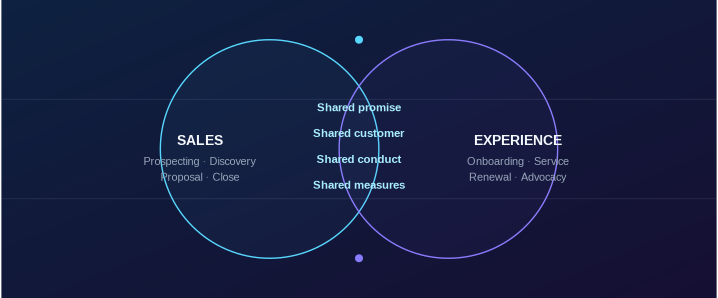
One system, four shared elements
Designing sales and experience as one system does not require merging teams. It requires four things to be shared across them.
1. A shared promise
Write down, in one or two sentences, what a customer should be able to expect from you — not the marketing line, but the operational commitment. Then test every sales message and every service process against it. If a sales conversation sets an expectation the service team cannot meet, change the conversation. If a service process makes a sales promise impossible to keep, change the process. The promise is the referee.
2. A shared picture of the customer
Both teams should work from the same description of who the customer is and what they are trying to achieve. In practice this means that discovery questions asked during the sale are chosen partly because the answers will be useful afterwards, and that those answers are captured in a form the next person can actually use. A representative who learns that a customer is anxious about installation timing has discovered something the delivery team needs to know.
The hand-off itself deserves to be designed rather than assumed. Decide what moves from the sale to the next stage: the customer's stated objective, any concerns raised, what was promised and by when, and the preferred way to be contacted. Decide the form it takes — a structured note is more reliable than a conversation in a corridor — and decide who confirms that it arrived. A hand-off nobody owns is a hand-off that will eventually be missed, and the customer is the one who notices.
3. A shared standard of conduct
The tone, honesty and respect that define a good service interaction should define a good sales interaction too. That includes being explicit about costs and conditions, representing limitations accurately, honouring a customer's decision to decline, and never using pressure to close a decision that the customer would regret. A sale won through a conversation the customer resents is an experience problem waiting to happen.
4. A shared measure of success
If the only number that matters at the point of sale is the sale, everything else will be sacrificed to it. A better set of measures looks at the quality of the sale as well as the quantity: whether the customer's expectations were set accurately, whether the hand-off was complete, whether early service contacts suggest confusion or confidence. These do not replace commercial measures. They sit alongside them and keep them honest.
Where the seam usually shows
It is worth knowing the moments where the gap between selling and serving tends to become visible, because they are the moments to design most carefully.
What this looks like in different channels
The principle is the same everywhere, but the practical implications differ.
Business sales
Long cycles produce a great deal of customer understanding. The hand-off to account management or delivery should carry all of it — the stakeholders, the concerns, the reason the decision was made — so the relationship continues rather than restarts.
Consumer and field sales
Decisions are faster and expectations are set in minutes. Clarity about what has been agreed, written confirmation, and an easy route to ask a question afterwards are what turn a quick decision into a confident one.
Retail, events and kiosks
The representative is often the brand's only human presence. How they explain the product, how they handle a question they cannot answer, and how they treat a shopper who decides not to buy all shape the experience whether or not a sale happens.
Putting it into practice
You do not need a transformation program to connect sales and experience. You need a handful of deliberate decisions.
When sales and experience are designed as one system, the sale stops being something the customer has to recover from and becomes the first good reason they have to trust you. That is the standard we design every program toward, and it is a standard any organisation can adopt.