
Most sales conversations fail quietly. Nobody is rude, nothing dramatic happens, and the customer walks away having learned very little about whether the offer was right for them. The representative talked, the customer nodded, and both left with the vague sense that it was a waste of time. The reason is almost always the same: the conversation was built around what the representative needed to say rather than what the customer needed to work out.
A better conversation is not a longer one, and it is not a friendlier one. It is one with a structure that puts understanding before explanation. This article sets out that structure, the habits that make it work, and the ways we prepare people to use it across business, consumer, field, retail, event and kiosk settings.
Why listening is the commercial skill that matters most
Every offer has a set of reasons someone might want it and a set of reasons they might not. A representative who talks first is guessing which of those reasons apply. A representative who listens first finds out. That difference compounds across every interaction in a program: the listener wastes less of the customer's time, explains fewer irrelevant features, hears objections earlier and recognises a poor fit before anyone is inconvenienced by it.
Listening also changes how the customer experiences the conversation. People can tell when they are being processed. They can also tell when they are being understood, and they tend to extend more patience, honesty and goodwill to the person who is doing the understanding. In short, listening is not the soft part of selling. It is the part that makes everything else work.
The four movements of a useful conversation
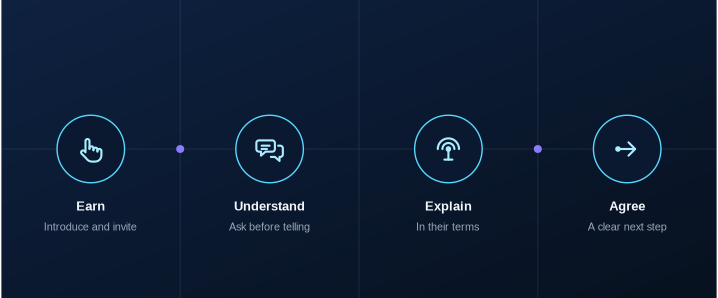
We think about a conversation in four movements. They are not a script, and they do not have to happen in a fixed order, but a conversation that misses any of them usually feels incomplete to the customer.
1. Earn the conversation
The opening has one purpose: to make it easy for the customer to decide whether to continue. That means a clear introduction, an honest statement of why you are speaking with them, and an explicit invitation to carry on or to stop. In a field or kiosk setting, this takes a few seconds. In a business setting, it may take an email and a short call. In every setting, the customer should never have to wonder who you are or what you want.
2. Understand before you explain
This is the movement most conversations skip. Before describing anything, find out what the customer's current situation looks like, what they are trying to achieve, and what has shaped their thinking so far. Good questions are open, specific and easy to answer. "What do you currently use for this?" is better than "Are you happy with your provider?" because it produces information rather than a reflexive yes or no.
The goal is not to collect a checklist of answers. It is to understand the customer well enough that your explanation can be about their circumstances rather than about the product in the abstract.
3. Explain in the customer's terms
Once you understand what matters, explanation becomes selective. You describe the two or three things that bear on this customer's situation, and you leave the rest for later or not at all. You use the words they used. You are explicit about what the offer does not do, because an honest limitation builds more trust than an unqualified claim. Where cost, commitment or conditions apply, you state them clearly and early rather than hoping they will not come up.
4. Agree the next step
A conversation should end with both people knowing what happens next. Sometimes that is a purchase or a sign-up. Often it is a follow-up call, a sample, a referral to a colleague, or a polite agreement that this is not the right fit. All of those are good outcomes if they are clear. The poor outcome is ambiguity — the customer unsure whether they agreed to something, or the representative unsure whether there is anything to follow up on.
Habits that separate good conversations from average ones
Structure gives a conversation shape. Habits give it quality. These are the ones we spend the most time on when preparing representatives.
How the structure adapts to different settings
The four movements are constant, but their proportions change with the environment.
Business-to-business
Understanding dominates. Discovery can span several conversations, and the "explain" movement often becomes a written proposal. The next step is usually a defined meeting with named people and a clear purpose.
Door-to-door and consumer outreach
Earning the conversation is everything. The introduction, the reason for the visit and the invitation to continue or decline must be immediate and unmistakable. Consent and opt-out requests are honoured without argument.
Retail, events and kiosks
Time is compressed. Understanding may be a single well-chosen question. Explanation is often a demonstration rather than a description. The next step might be a purchase at the counter, a sample or simply a clearer idea of the product.
Putting it into practice
If you want to improve the conversations happening in your name, start with these steps rather than a new script.
Better conversations are not a matter of personality. They are the product of preparation, structure and the discipline to listen before speaking. Those are things a program can be designed to deliver consistently — which is precisely what we help organisations do.